
Wirepas
Decentralised, high-density mesh network software that also supports location.
Role: Communication, location
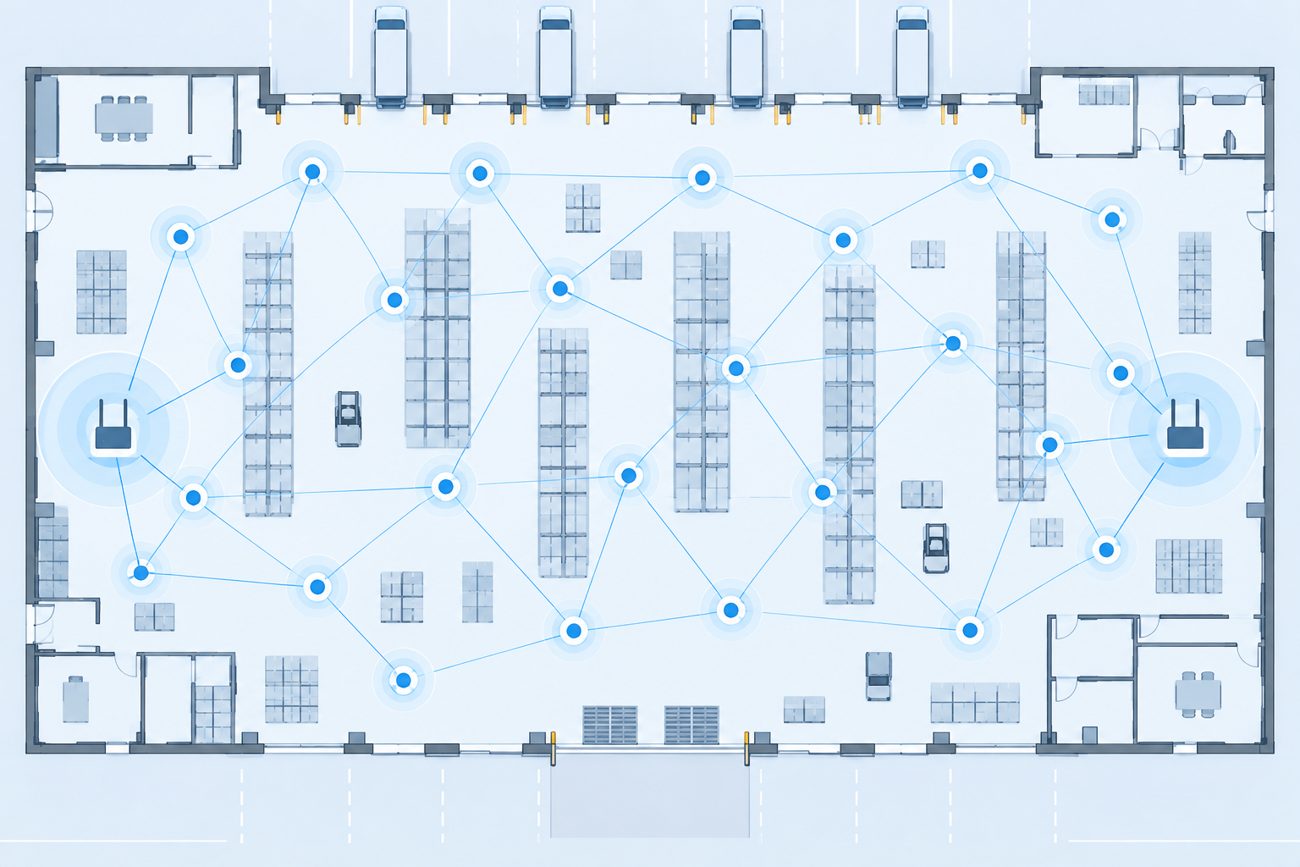
In short
Wirepas Mesh is a decentralised wireless mesh technology: the devices themselves make decisions locally, with no central control. This article covers Wirepas Mesh 2.4 GHz; Wirepas also offers separate radio profiles.
History
Wirepas grew out of a University of Tampere research project: according to the company's story, work started in 2000 and by 2010 it had become the Wirepas known today. Wirepas Mesh 2.4 GHz uses the same modulation (GFSK) and channel allocation as BLE, so it runs on standard SoCs. Wirepas 5G Mesh is a separate product: according to the vendor it is a new radio profile (NR+, a dedicated licence-exempt band around 1900 MHz, OFDM), not a modification of the 2.4 GHz protocol.
How it works
Every device can route and there can be several gateways. According to the vendor, devices use the channels they sense as free, with hop-by-hop acknowledgement and adaptive transmit power, and the network is self-healing.
Uses
Large sensor networks, smart meters, lighting, and indoor tracking of equipment, pallets, tools and people in warehouses, production, construction and healthcare.
Advantages
Infrastructure consists of anchors placed at fixed points with no extra wiring, and the network also carries sensor data and commands. According to the vendor, the network supports high density and multi-year battery life.
Limits
Wirepas Mesh 2.4 GHz is the vendor's own protocol stack, not a general industry base standard (the 5G Mesh profile is not covered here). It calculates position from RSSI measurements, so accuracy depends on anchor density and the environment. The performance figures (for example node counts, read rates) are the vendor's claims. The documentation says support for the positioning engine (WPE) is ending in favour of the network management system (NMS), so check the current state on a new project.
Related
BLE, LoRaWAN, Zigbee, UWB.