
Active RFID (overview)
Tags with their own power source that transmit their own signal. An umbrella term: the actual capabilities come from the radio technology used.
Role: Identification, communication, location
In short
An active RFID tag runs on its own battery or accumulator and transmits its signal by itself at regular intervals. That is why it can be tracked from a greater distance and continuously, unlike a passive tag, which can only be read inside a reader field.
History
ISO/IEC 18000-7 is the standard air interface for active tags in the 433 MHz band (current edition 2014). Most of today's systems are built on other radio technologies, so "active RFID" is now more of an umbrella name.
How it works
The tag signal is received by fixed receivers, location sensors or gateways, and software calculates the position or zone from them. The transmit rate (blink rate) is programmable and sets battery life and tracking density.
Uses
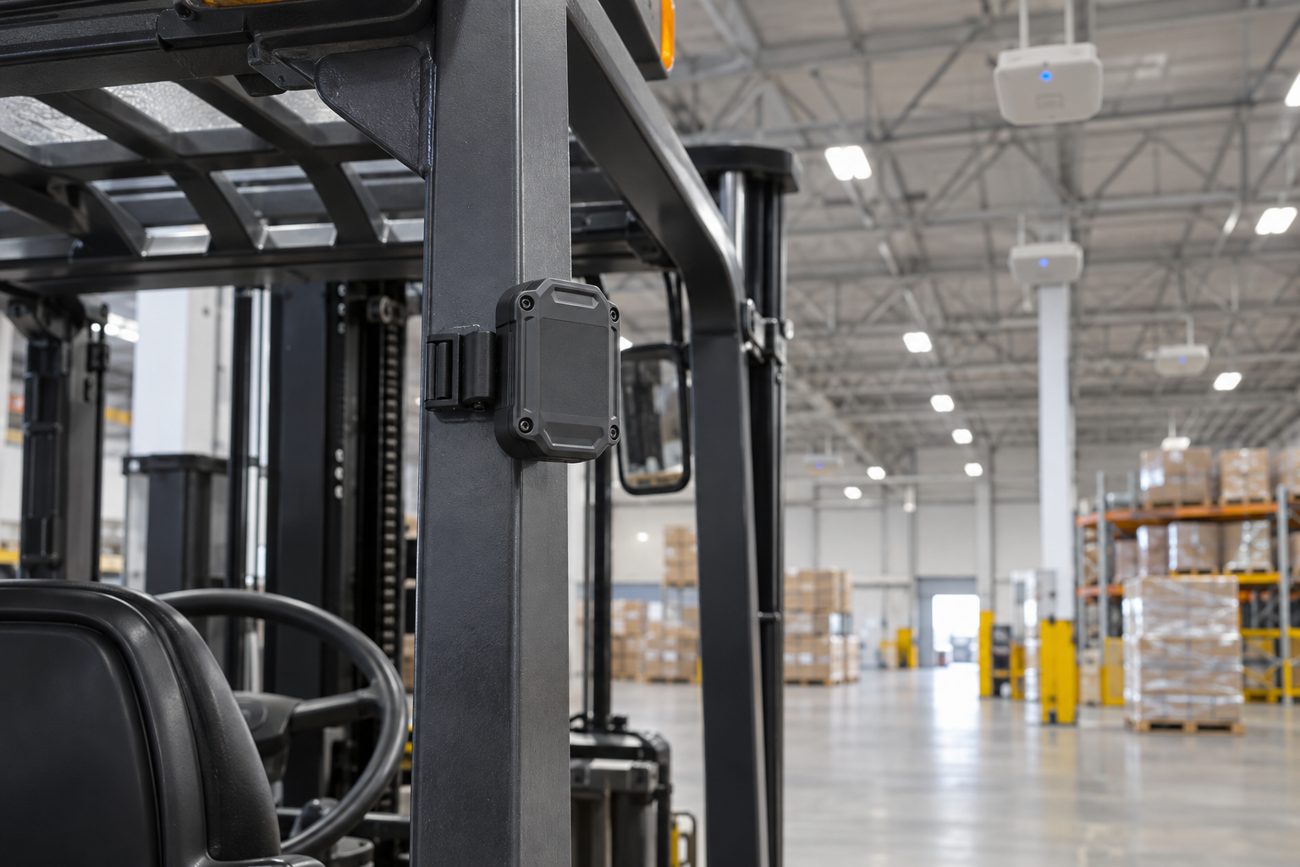
Continuous tracking of equipment, forklifts, containers, trailers, hospital equipment and ID badges, optionally with temperature and humidity data. The data usually goes to a warehouse or production management system.
Advantages
It gives continuous visibility, not only at the points where an item passes a reader. Range varies widely by system, and the sources mention distances in the thousands of metres for long-range solutions.
Limits
The tag needs a power source, so it is typically more expensive and larger than a passive tag; battery life depends on the transmit rate and the type. For well-defined processes where items pass a fixed point, passive RFID or a barcode is often enough and cheaper.
Related
Passive RFID UHF and HF, BLE, Wirepas, UWB, GPS tracking.