
Passive RFID: UHF
Radio reading of passive (no power source) tags in the UHF band, also known as RAIN RFID.
Role: Identification
In short
The antenna of a passive UHF RFID tag provides the energy for its response. The name RAIN RFID refers to passive UHF RFID (ISO/IEC 18000-63, also known as GS1 UHF Gen2).
History
EPCglobal first published the EPC Gen2 protocol in 2004. Gen2v2 (data security and privacy) followed in 2013, and the latest is Gen2v3. The name RAIN was adopted in 2014 for the industry alliance.
How it works
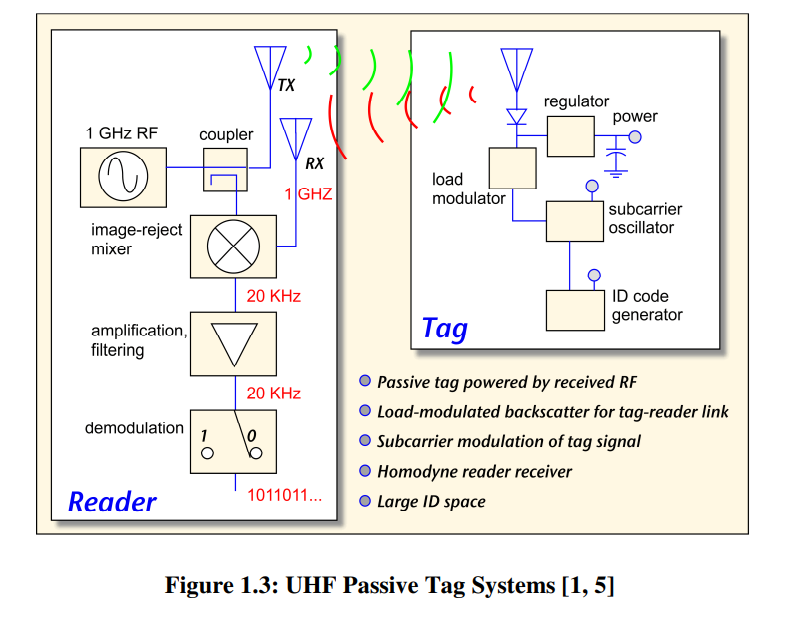
The passive tag reflects the reader signal (backscatter) and modulates it with its data. The protocol describes readers and passive tags in the 860-930 MHz range. A tag can carry an EPC identifier, which can hold GS1 keys.
Uses
Mainly used for fast asset identification, inventory and tracking. Capturing unique EPCs can improve supply chain visibility and inventory accuracy. Vendor example: warehouse inventory tracking at Incora (Case studies).
Advantages
Readable without line of sight and at high speed, and it can work through most materials such as cartons, boxes or wood. A passive tag has no battery to replace, but the tag and its attachment can still age or fail over time.
Limits
Range depends on the tag, reader, antenna, power and environment: up to 10 m is possible in good conditions. Near metal and liquids reading can degrade, and in such environments a barcode can be more reliable, so test tag type and placement on site. RFID reading is not 100% either, and tagging costs more than direct barcode printing.
Related
Barcode (supports the same GS1 standards), Passive RFID HF, Active RFID overview.
Related pages
- Barcode
- Passive RFID: HF
- Related case study: Incora (Vendor example, not an XperiBox reference.)
- Back to the knowledge base