
Zigbee
A low-power mesh networking standard built on the IEEE 802.15.4 radio.
Role: Communication
In short
Zigbee is a low-power mesh networking specification built on the IEEE 802.15.4 physical layer. It defines the network and application layers as well.
History
The specification is maintained by the Connectivity Standards Alliance (CSA), with a certification programme for interoperability. It describes the physical layer for the 2.4 GHz band and for sub-GHz bands.
How it works
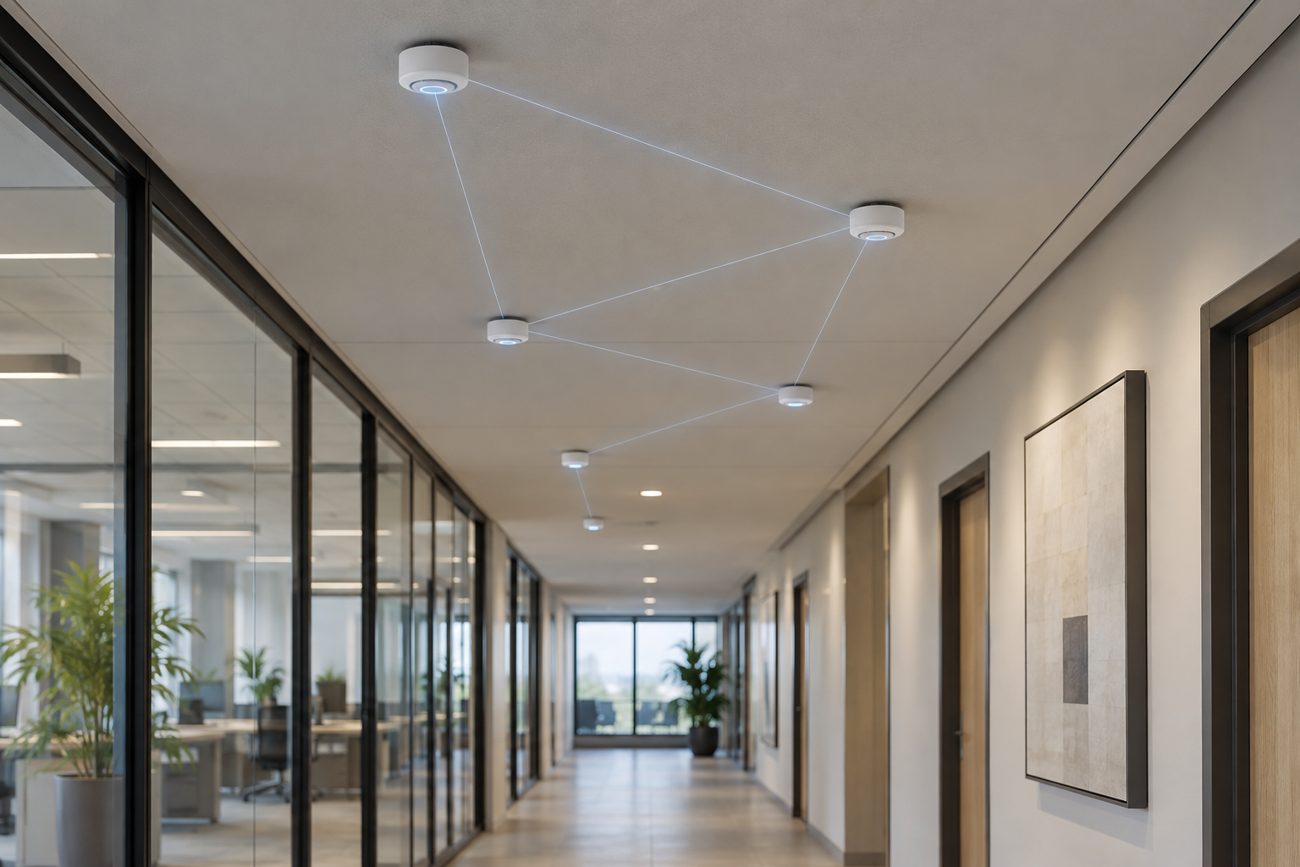
Zigbee devices form a self-organising, self-healing mesh where intermediate nodes forward messages. Raw data rate is 250 kbit/s at 2.4 GHz, and the sources give a transmission distance of 10 to 100 metres depending on conditions.
Uses
Building automation, commercial buildings, smart meters and the energy grid, and home automation.
Advantages
Low power consumption, self-healing mesh, a wide choice of certified products, and a network that can handle hundreds of nodes. It also supports Green Power energy-harvesting devices.
Limits
Built for low data rates, not for heavy traffic. Actual network size depends on the band and traffic. It is not a location technology, so position needs another method. The 2.4 GHz band is shared with other systems.
Related
Wirepas, LoRaWAN, BLE.