Status: solution concept, under validation.
The challenge
With a large number of stored items, whether archive boxes, documents, production tools, returnable packaging or other assets, the recorded storage location and the actual location can drift apart over time. Finding one misregistered or moved item can take days, and the search itself can introduce new errors.
The concept
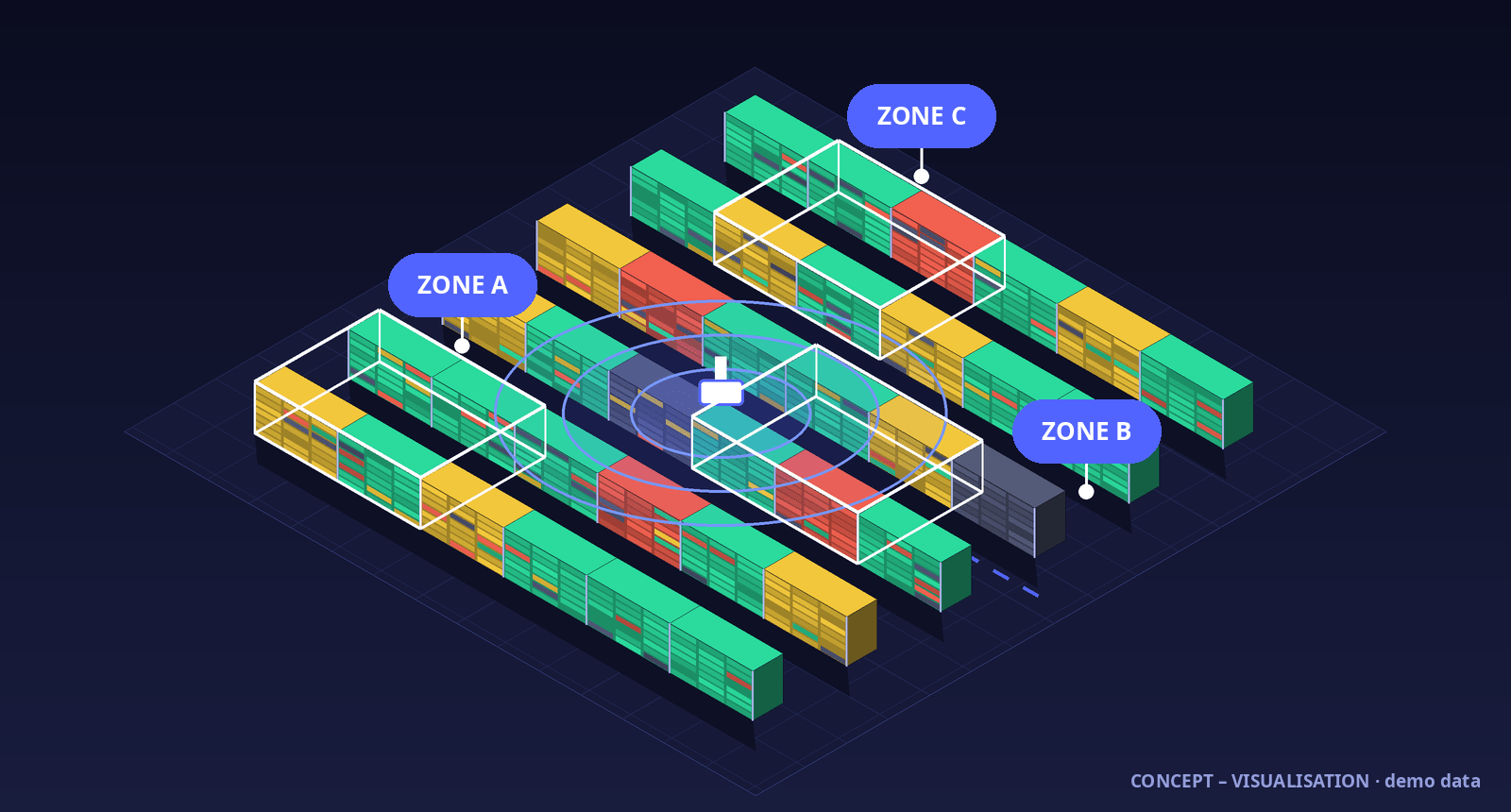
Every item gets a UHF RFID tag. Material-handling equipment such as forklifts carries an RFID reader and antennas, and the racks carry reference tags with known positions recorded in a 3D model of the warehouse. During put-away and moves, the forklift reader reads the tags on the load together with nearby reference tags, and from the signal-strength (RSSI) data the system determines a zone around the item. A handheld RFID finder then pinpoints the exact spot within the zone.
A general data model: asset, place, event
The core of the solution is asset-agnostic: it is built on the triple of asset (box, document, tool, returnable packaging), place (reference point, zone) and event (read, move). The same core can serve archive boxes, documents, the tools of an injection-moulding plant, returnable packaging or other assets: the same logic, different asset types.
Continuous inventory
Forklifts read continuously during daily work, so the system refreshes stock data without separate inventory rounds. For each item it always stores the reference point with the strongest RSSI value. The 3D warehouse model uses colours to show when each area was last inventoried, for example within the last two weeks, one month, or longer ago, making it visible where the information is ageing.
Reports and search
On the desktop interface, searches can be started and reports requested, both with field-based filters and with natural-language, prompt-based queries. The handheld device focuses on search.
Operation and security
The system can run as an island inside the customer's own environment: data stays on site, access is role-based, and operations can be audit-logged. ERP or other enterprise integration can be added later, as needed.
Honest limitations
Zone size and read reliability depend heavily on the environment: metal shelving, liquids and dense materials can shadow the radio signal. The concept is therefore under validation, and we would state real accuracy figures only after an on-site pilot with blind-search tests. The recommended first step is a limited-scope pilot in the real environment.