
Machine Vision
Automatic inspection, measurement and guidance based on image processing in industrial environments.
Role: Visual inspection
In short
Machine vision is the engineering field of automatically capturing, processing and interpreting image data to guide machines or make measurements in industrial environments.
History
Industrial applications appeared in the late 1970s, when semiconductor image sensors and microprocessors became affordable. Early systems inspected printed circuit boards for missing components and checked label placement.
How it works
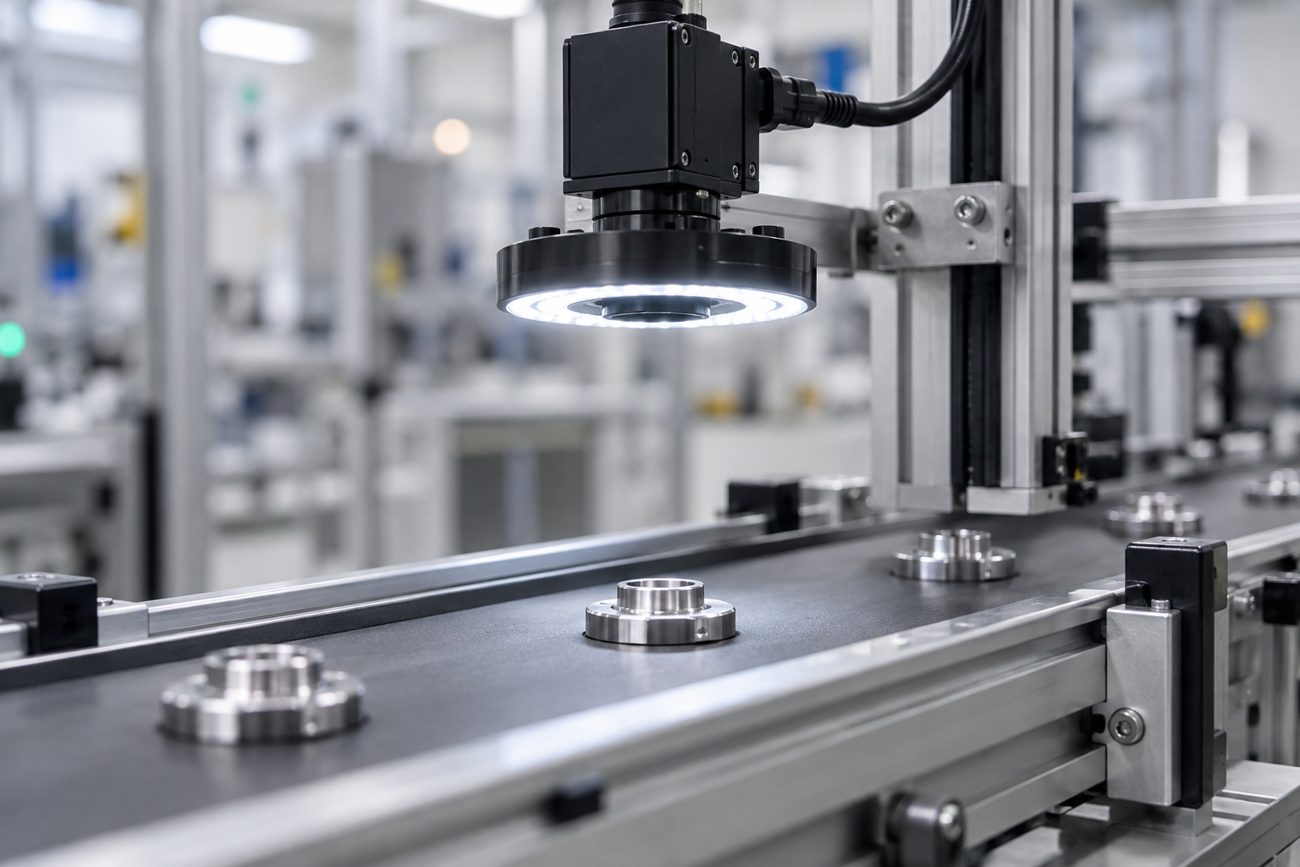
A system consists of a camera (a smart camera, or a multi-camera setup with a separate processor), a lens, lighting and image processing software. The camera can be area-scan or line-scan, and lighting can be backlighting or front lighting.
Uses
Inspection and quality control, dimensional measurement, recognising part position and shape, sorting and robot guidance. Smart cameras also appear as code readers. The output is often a pass/fail decision.
Advantages
It can work fast and continuously, at speeds and resolutions beyond human vision. Measurement can be embedded in the production line and gives data for improving the process.
Limits
Lighting is critical: a solution that works in the lab may fall short in live production. Resolution and processing speed trade off against each other. How the part is presented (position, surface, reflections) affects the result, so test the system with real parts.
Related
Barcode (image-based reading), passive RFID, GPS tracking.
Related pages
- Barcode
- Active RFID (overview)
- Related case study: Schaeffler (Vendor example, not an XperiBox reference.)
- Back to the knowledge base